From Osek Murshe to a Limited Company in Israel
Moving from osek murshe to an Israeli limited company usually makes sense when your profit has grown and you do not need all of it to live on, when partners join, or when you want to separate the business from your personal assets. A company is taxed differently and adds obligations such as double-entry books, audited financial statements and reports to the Registrar of Companies, so we look at the full picture before recommending it.
What changes when I move to a limited company?
The company becomes a separate legal entity. Its profit is taxed at the corporate level, money reaches you as salary or dividends, and you take on double-entry bookkeeping, an annual audit and reporting to the Registrar of Companies.
What are the ongoing costs of a company?
A company has costs that an osek murshe does not: an annual fee to the Registrar of Companies, double-entry bookkeeping and an auditor's review of the financial statements. These are part of the decision, alongside the tax difference.
What are the downsides of moving to a company?
More reporting and more obligations: double-entry books, an annual CPA audit, an annual fee to the Companies Registrar and separate reports for the company and its owners. Taking money out of the company also needs planning, because it is taxed as salary or as a dividend.
Does a limited company protect my personal assets?
The company is a separate legal entity, and its debts are usually its own. The protection is not absolute: a personal guarantee you sign, for example to a bank, still binds you, and in exceptional cases a court can hold owners personally liable. It is worth checking this with a lawyer as well.
What actually moves to the company?
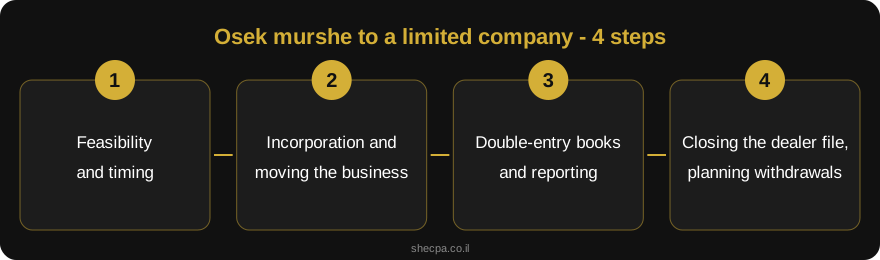
Clients and contracts, the bank account and card clearing, suppliers and open orders, stock and equipment. Each has tax and VAT aspects, so the order of the move is planned in advance.
| Osek murshe | Limited company | |
|---|---|---|
| Legal status | You personally | A separate legal entity |
| Tax on profit | Personal income tax at progressive rates | Corporate tax, plus tax when money is paid out |
| Bookkeeping | Relatively simple | Double-entry |
| Annual reporting | Personal tax return | Audited financial statements and company return |
| Liability for business debts | Personal | Generally the company's |
Who this is for
- Self-employed English speakers considering incorporation
- Business owners whose activity has grown beyond a sole-trader structure
- Partners who want a proper legal structure for a joint business
What we do
- Checking whether incorporation makes sense, and when
- Moving the activity into the new company
- Setting up double-entry bookkeeping and the required reporting
- Ongoing company accounting, audit and tax planning, in English
Should I incorporate my business in Israel?
It depends on your profit, how much of it you need to draw, your plans and non-tax factors such as liability. We make the assessment on your actual numbers.
How is a company taxed compared with an osek murshe?
An osek murshe pays personal income tax on all of the profit at progressive rates. A company pays corporate tax on its profit, and further tax is due when money is paid out to the owners as salary or dividends.
What happens to my osek murshe file after incorporation?
If the whole activity moves to the company, the osek file is closed with VAT, income tax and National Insurance, with a final report. If part of the activity stays personal, the file continues alongside the company.
Official sources
Related services
- English-Speaking Accountant & CPA in Israel
- Opening a Company in Israel: CPA Support in English
- Switching from Osek Patur to Osek Murshe in Israel