Opening a Company in Israel: CPA Support in English
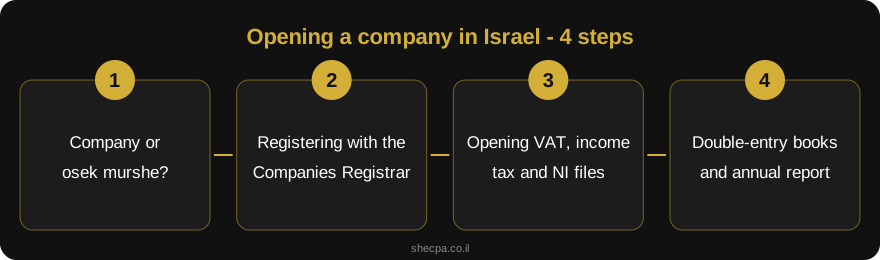
Opening a company in Israel means registering with the Registrar of Companies, opening files with VAT, income tax and National Insurance, and setting up double-entry bookkeeping. It can suit a business that starts big, partners, or anyone who needs to separate the business from personal assets. We help you decide whether a company is right for you now, coordinate the registration and files, and run the books from the start, in English.
Should I open a company or register as osek murshe?
It depends on expected profit, partners, the level of risk and your plans. A company usually suits a profitable activity where some profit stays in the business, or where you need separation from the owners. For a small activity at the start, osek murshe is usually simpler and cheaper.
What are a company's obligations after it opens?
Periodic VAT and income tax reporting, double-entry bookkeeping, annual financial statements audited by a CPA, an annual return to the Tax Authority, and an annual report and fee to the Registrar of Companies.
Who can open a company in Israel?
One person can open a company and be both its only shareholder and its director. You need at least one shareholder and one director.
How do I choose a company name?
You submit a preferred name and alternatives to the Companies Registrar, which checks that the name is not identical or too similar to an existing company, so it is worth preparing a few options.
What happens right after registration?
You open a bank account in the company name, open VAT, income tax and National Insurance files, and set up double-entry books. Only then can the company start trading properly.
Who this is for
- Entrepreneurs starting a new business in Israel
- Partners who want a proper joint structure
- New immigrants and foreign residents opening a business in Israel
- Self-employed people whose business has grown
What we do
- Assessing a company against an osek murshe for your plans
- Coordinating registration with the Registrar of Companies and the tax files
- Setting up double-entry bookkeeping, withholding and payroll
- Ongoing reporting, audited financial statements and the annual return
How long does it take to open a company in Israel?
Registering the company itself is usually done online and relatively quickly. Opening the tax files and setting up the accounts takes longer, so it is best to start before the business begins trading.
Can a foreign resident or new immigrant open a company in Israel?
Yes. There are document and identity requirements, and for foreign residents there are also residency and international tax aspects to review.
Does an Israeli company need an accountant?
Yes. An Israeli company must prepare annual financial statements audited by a CPA. An accountant who is involved from the start also advises on drawing money, tax planning and dealing with the authorities.
Official sources
Related services
- English-Speaking Accountant & CPA in Israel
- From Osek Murshe to a Limited Company in Israel
- Switching from Osek Patur to Osek Murshe in Israel